PrimaMed insights

Articles

Practical guidance on medical aid billing, claims and practice admin — written for South African healthcare practices.

← All articles Technology · 1 min read

The Technology Advantage

How AI, automation and cloud-based platforms improve claim accuracy, speed up submissions and give practices real-time financial visibility.

The Technology Advantage

Medical billing has changed a great deal in recent years. Today's billing systems use automation and smart analytics to spot why claims are being rejected, track how and when medical aids pay, and highlight where revenue is being lost. Automated checks catch errors before a claim is submitted, claims reach medical aids faster, and practices can see their financial position at any time instead of waiting for month-end.

Cloud-based billing platforms also connect with practice management and patient record systems, so information flows between them without being captured twice. Buying, maintaining and learning these tools in-house is costly for a single practice. Working with a billing bureau gives you the benefit of this technology without the overhead.

Thinking about outsourcing your billing? PrimaMed can help you take the admin off your team.

← All articles Outsourcing · 2 min read

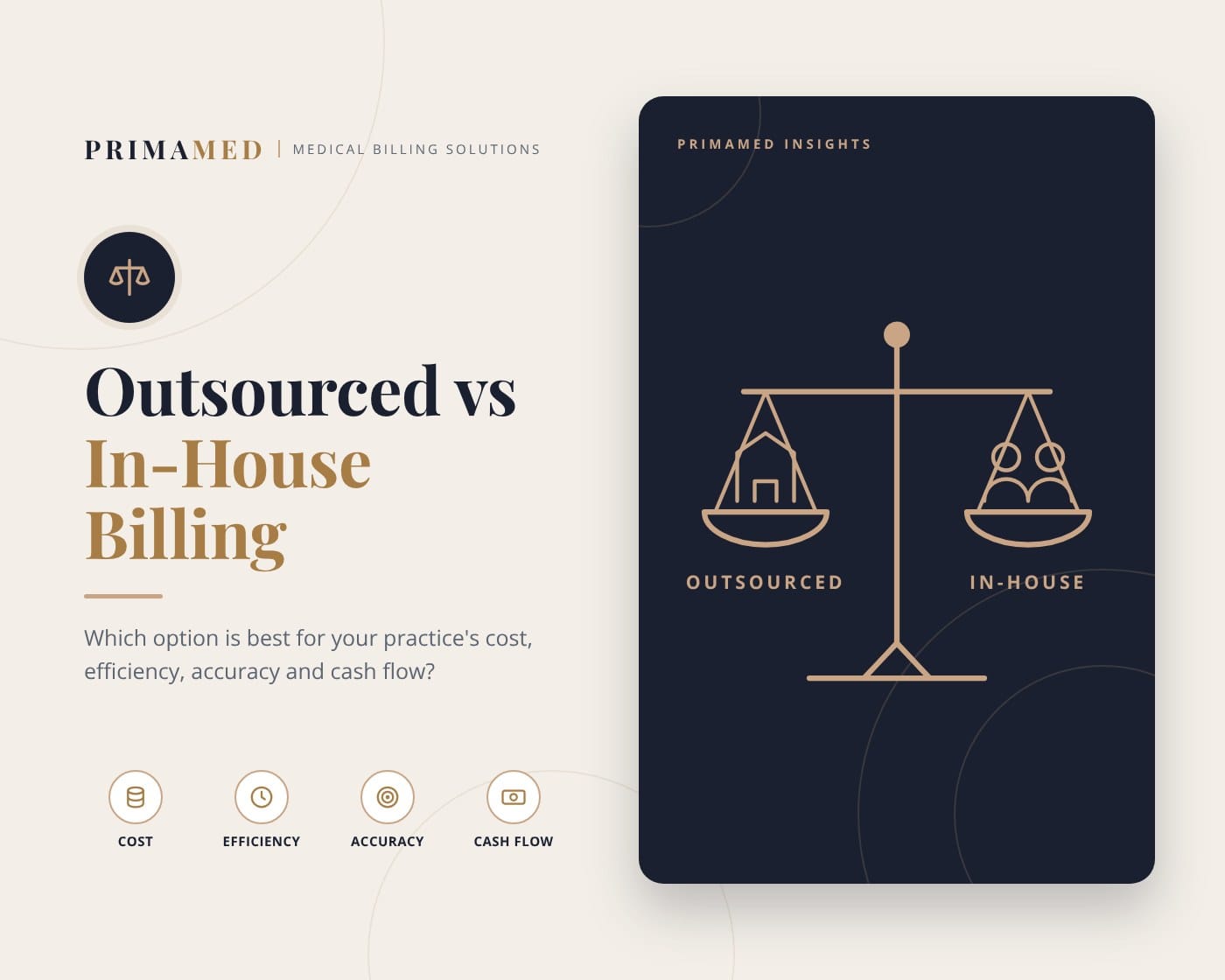
Outsourced Billing vs In-House Billing

Compare outsourced and in-house medical billing to decide which option is best for your practice's cost, efficiency, accuracy, and cash flow.

Outsourced Billing vs In-House Billing

Medical practices often ask whether they should manage billing internally or outsource it to a specialist provider. Both options can work, but the right choice depends on your practice size, team capacity, claim volume, systems, and financial goals.

In-house billing

In-house billing gives the practice direct control over the billing process. Your team is close to the day-to-day operations, understands your patients, and can communicate directly with clinical staff.

However, in-house billing also requires training, supervision, software knowledge, and consistent follow-up. If the responsible staff member is absent, overloaded, or inexperienced, claims may be delayed and rejections may increase.

In-house billing can also become costly when you factor in salaries, leave cover, training, software use, and management time.

Outsourced billing

Outsourced billing gives your practice access to billing specialists who focus on claims, rejections, payment follow-up, and reporting every day. This can improve consistency and reduce the burden on reception and admin staff.

An outsourced provider can also help identify revenue cycle problems that are easy to miss internally, such as recurring rejection patterns, delayed submissions, or unpaid claims that need attention.

The main consideration is choosing the right partner. Your billing provider should communicate clearly, protect patient information, understand medical aid processes, and provide useful reporting.

Cost comparison

In-house billing may appear cheaper at first, but hidden costs can add up. These include staff time, training, errors, delayed collections, and lost revenue from claims that are not followed up properly.

Outsourced billing is usually a defined service cost, making it easier to measure against improved collections, reduced admin time, and better reporting.

Which option is right for your practice?

If your team has strong billing experience, enough time, and reliable systems, in-house billing may work well. If billing is creating pressure, delays, rejections, or poor cash flow visibility, outsourcing may be the better option.

How PrimaMed helps

PrimaMed provides outsourced medical billing support designed to improve accuracy, follow-up, and revenue cycle performance. We help practices reduce admin stress while keeping billing organised and accountable.

Considering outsourced billing? PrimaMed can help you compare your options and choose the best fit for your practice.

← All articles Claims · 2 min read

Common Medical Aid Billing Mistakes

Avoid common medical aid billing mistakes that lead to claim rejections, delayed payments, patient disputes, and lost revenue.

Common Medical Aid Billing Mistakes

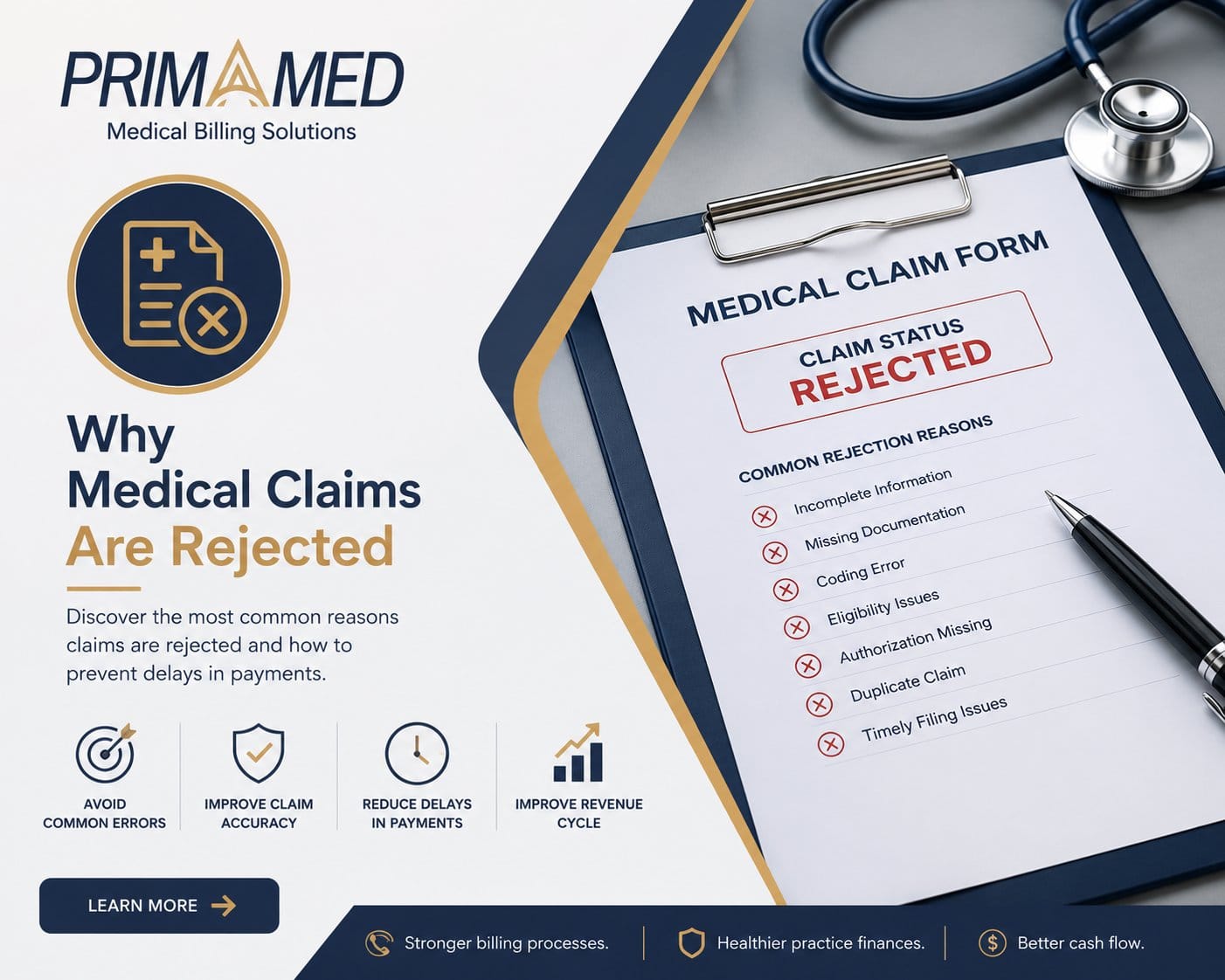
Medical aid billing is detailed work. Even small mistakes can delay payment or cause claims to be rejected. By understanding the most common errors, practices can prevent unnecessary admin and protect revenue.

Incorrect patient information

Wrong membership numbers, dependent codes, dates of birth, or plan details are common causes of rejection. Patient information should be checked regularly, especially when patients change medical aids or plan options.

Missing authorisation

Some services require authorisation before treatment or before a claim is submitted. If authorisation is missing, expired, or linked to the wrong service, the medical aid may reject the claim.

Incorrect coding

Tariff codes, diagnosis codes, modifiers, and service dates must match the treatment provided. Coding errors can lead to rejected claims, short payments, or requests for additional information.

Late claim submission

Medical aids have submission deadlines. Claims submitted too late may not be paid, even if the service was valid. Practices should submit claims promptly and monitor deadlines closely.

Duplicate claims

Submitting the same claim more than once without checking the status can create confusion and delays. A proper tracking process helps prevent unnecessary duplicates.

Poor follow-up

A claim that is rejected or unpaid still needs action. Without regular follow-up, outstanding amounts can become old and harder to collect.

Incomplete supporting documents

Some claims require reports, motivations, referral letters, or other supporting documents. Missing documents can delay processing or lead to rejection.

How to avoid these mistakes

Use a consistent billing workflow, check claims before submission, review rejection reports, and follow up unpaid accounts regularly. Training and specialist billing support can also reduce errors.

How PrimaMed helps

PrimaMed supports practices with accurate claim submission, rejection management, follow-up, and reporting. We help prevent common billing mistakes before they affect your cash flow.

Avoid costly billing errors. PrimaMed can help your practice get claims right the first time.

← All articles Patient admin · 2 min read

Why Accurate Patient Information Matters

Accurate patient information leads to smoother claims, fewer rejections, better communication, and faster medical aid payments.

Why Accurate Patient Information Matters

Accurate patient information is one of the simplest ways to prevent billing problems. A claim can be clinically valid and correctly coded, but still be rejected if the patient details are wrong.

Small errors create big delays

Incorrect membership numbers, dependent codes, initials, ID numbers, dates of birth, or plan options can stop a claim from processing. The practice then has to contact the patient, correct the information, resubmit the claim, and wait again.

These delays affect cash flow and increase admin work.

Patient details can change

Medical aid details are not always the same from one visit to the next. Patients may change schemes, move to a different plan, add or remove dependants, or have membership suspended.

That is why information should be checked regularly, not only when a patient first visits the practice.

Accurate information improves communication

Correct contact details are also important. If a patient has a co-payment, short payment, or outstanding balance, the practice needs to reach them quickly and professionally.

Outdated phone numbers or email addresses can make patient account management much harder.

Better data supports better reporting

Accurate patient information helps produce cleaner reports. When accounts are linked correctly and payments are allocated properly, the practice can see its true financial position.

Reliable data makes it easier to identify outstanding claims, patient balances, and scheme payment issues.

How practices can improve accuracy

Practices should confirm patient details at every visit, request updated medical aid cards where appropriate, check dependent codes, and ensure authorisations match the correct patient and service.

Staff should also understand why these checks matter. They are not just admin tasks; they directly affect payment.

How PrimaMed helps

PrimaMed supports accurate billing by checking key claim information, identifying common data errors, and helping practices improve their billing process. Better information means fewer delays and stronger collections.

Accurate details lead to faster payments. PrimaMed can help keep your billing information clean and reliable.

← All articles Authorisations · 2 min read

Understanding Medical Aid Authorisation

Learn when medical aid authorisation is needed, why it matters, and how it helps prevent claim rejections and payment delays.

Understanding Medical Aid Authorisation

Medical aid authorisation is approval from a medical scheme for certain healthcare services before they are provided or claimed. It does not always guarantee full payment, but it is often required before a claim can be processed.

When authorisation may be needed

Authorisation is commonly required for hospital admissions, procedures, specialist treatment, scans, chronic medication, and certain high-cost services. Requirements differ between medical aids and plan options.

Because rules vary, practices should confirm authorisation requirements before treatment wherever possible.

Why authorisation matters

If a service requires authorisation and the practice does not obtain it, the claim may be rejected or paid only partially. This can create financial stress for both the practice and the patient.

Authorisation also helps patients understand what their medical aid may cover and whether they may have a co-payment or shortfall.

What information is usually needed

Medical aids may ask for patient details, membership information, diagnosis codes, procedure codes, clinical motivation, dates of service, provider details, and supporting documents.

The more accurate the information, the smoother the authorisation process is likely to be.

Common authorisation problems

Problems often occur when authorisation is requested too late, the wrong codes are used, the authorisation does not match the service provided, or the authorisation number is missing from the claim.

Practices should check that the authorisation details match the claim before submission.

Authorisation and patient communication

Patients should be informed that authorisation is not the same as a payment guarantee. Benefits, limits, exclusions, and co-payments may still apply.

Clear communication helps reduce misunderstandings after treatment.

How PrimaMed helps

PrimaMed helps practices manage the billing side of authorisation by checking claim requirements, ensuring authorisation details are included correctly, and following up where claims are affected.

Need fewer authorisation-related rejections? PrimaMed can help keep the process organised.

← All articles Technology · 3 min read

The Evolution of Automated Medical Billing With Artificial Intelligence

How AI is changing coding, claims processing and fraud detection, and what it means for South African practices.

The Evolution of Automated Medical Billing With Artificial Intelligence

Medical billing has never been simple. Every claim depends on accurate patient details, correct ICD-10 and tariff codes, and timely follow-up with medical aids. For years this work was almost entirely manual. Today, artificial intelligence (AI) is changing how it gets done.

From manual capture to automated coding

Billing used to mean reading clinical notes, choosing codes by hand and capturing claims one at a time. AI-assisted coding tools can now read clinical documentation and suggest the correct diagnosis and procedure codes. This makes coding more consistent and reduces the small human errors that lead to rejected claims.

Faster, cleaner claims

AI systems learn from large volumes of past claims. They can flag missing information, mismatched codes or authorisation gaps before a claim is submitted, so fewer claims come back rejected and payments arrive sooner.

Spotting errors and fraud

The same pattern recognition helps identify unusual billing activity, duplicate claims and discrepancies that may point to errors or fraud. Problems are picked up and corrected early, which improves transparency and helps practices stay compliant with medical aid rules.

Better financial insight

AI-driven reporting shows trends in rejections, payment times and outstanding balances, helping practices understand where revenue is being lost and what to fix.

The challenges

AI is not a replacement for experienced people. Patient data must be protected in line with POPIA, algorithms can carry bias from the data they learn from, and not every practice has the systems to support new technology. Human review remains essential to catch what software misses and to handle queries that need judgement.

What this means for your practice

AI is making billing faster, more accurate and more cost-effective. Practices don't need to build or buy these tools themselves. A billing bureau that combines technology with experienced billers gives you the benefits without the cost and complexity.

Thinking about outsourcing your billing? PrimaMed can help you take the admin off your team.